
In today’s business world, one truth remains constant whether you operate online, offline, or somewhere in between:
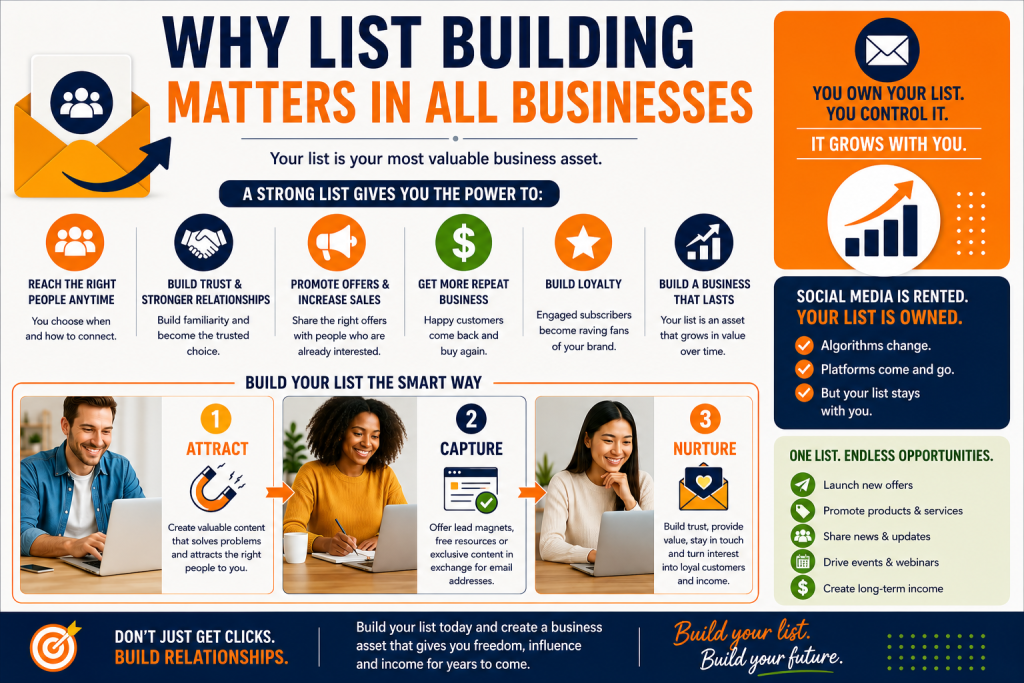
Creating a list is one of the more valuable assets any business can own.
Many Entrepreneurs/Business Persons spend an inordinate amount of time attempting to attract customers/clients, yet very few focus on maintaining direct contact with persons who have shown interest in their offerings. It is for this reason that building and maintaining a list becomes not merely necessary but essential.
A list is simply a collection of people who have given you permission to communicate with them. This could be an email list, a text message list, a customer database, or a contact list of prospects and clients.
The businesses that consistently grow are usually the businesses that consistently build and nurture their lists.
For further in depth explanation Check out The ClickBank Profit Club here
Why a List Matters More Than Ever
Social media platforms change.
Advertising costs rise and sometimes access to ad platforms is denied/cancelled
Search engine rankings fluctuate.
Market trends come and go.
But when someone willing joins your list, you gain a direct line of communication with them.
Instead of merely relying on or hoping people see your latest social media post, a list allows you to reach out to them directly with valuable information, updates, promotions, and offers.
A list helps you:
- Build trust over time
- Stay connected with prospects
- Generate repeat business
- Increase customer loyalty
- Create predictable sales opportunities
- Build a valuable business asset
In many instances, people do not buy the first time they hear about a product or service. Often, they need multiple interactions before deciding to purchase. To this end, a well-maintained list allows us to continue that conversation.
Starting A List: Begin with People You Already Know
One of the biggest mistakes some business owners make is believing they need thousands of strangers before they can start building a list.
The truth is much simpler.
Start with the people who already know you.
Friends and Family
Friends and family can become your first supporters.
While not everyone will become a customer, they can:
- Join your list
- Provide feedback
- Share your content
- Refer others
- Help spread awareness
Let them know what you’re doing and how your business helps people. Too many entrepreneurs overlook this integral starting point.
Warm Contacts and Referrals
The next group consists of people connected to your existing network.
These may include:
- Customer referrals
- Business associates
- Local contacts
- Professional connections
- Community members
Referrals are particularly powerful because trust has already been established through a mutual connection.
People are at times more willing to engage with a business when introduced by someone they know.
Make it easy for satisfied customers and contacts to refer others by providing simple ways to share your information.
Expanding to the Wider Public
Once the initial foundation has been explored and built to some degree of success, it’s time to attract people beyond your immediate network and outside our comfort zones.
This is where consistent marketing becomes important.
Use of Social Media Content
Posting useful content regularly can attract people interested in your expertise.
Focus on:
- Solving problems
- Answering common questions
- Sharing insights
- Providing tips and guidance
Useful content naturally attracts attention and encourages people to join your list.
Lead Magnets
A lead magnet is something valuable offered in exchange for contact information.
Examples include:
- Checklists
- Guides
- Reports
- Templates
- Mini courses
- Resource libraries
People are more often inclined to provide their email address when they are in receipt of receive genuine value.
Blogs and Articles
Well-written articles help establish credibility and attract visitors through search engines.
Each article can include opportunities for readers to subscribe and stay connected.
Video Marketing
Videos can build trust quickly because people get to see and hear you.
Platforms such as YouTube, Facebook, Instagram, TikTok, and LinkedIn can all help attract subscribers.
Webinars and Online Workshops
Educational presentations remain one of the most effective list-building tools available.
People register with their contact information and often become highly engaged subscribers.
Partnerships and Collaborations
Working with complementary businesses can expose you to entirely new audiences.
Joint webinars, guest articles, interviews, and collaborative projects can generate quality leads for both parties.
Unique and Creative Ways to Build a List
Many businesses focus only on traditional methods. However, some of the fastest-growing lists are built using more creative approaches.
Host a Challenge
A five-day or seven-day challenge can attract highly motivated participants.
Examples include:
- Fitness challenges
- Business challenges
- Productivity challenges
- Financial planning challenges
Participants typically register with their email address to join.
Interactive Quizzes
People enjoy discovering information about themselves.
Quizzes can generate engagement while collecting contact details from interested participants.
Local Events and Workshops
Offline businesses can collect contacts at:
- Trade shows
- Networking events
- Community fairs
- Educational workshops
- Charity events
Face-to-face interactions often create stronger initial connections.
Exclusive Communities
Private groups, membership communities, and special interest clubs can be excellent list-building tools.
People appreciate belonging to a group where they can learn and connect with others.
Contests and Giveaways
When done correctly, contests can generate attention and attract new subscribers.
The key is ensuring the prize attracts people who are genuinely interested in your business rather than people simply seeking free items.
List Building in the Direct Selling Industry
For direct sellers, network marketers, and relationship-based businesses, list building is also absolutely essential.
The strongest direct selling businesses are founded on lasting relationships.
Build Three Separate Lists
Much like in other conventional businesses, successful direct sellers maintain segmented lists:
- Prospect Lists – People who may be interested in the opportunity.
- Customer Lists – Existing and potential product customers.
- Partner Lists – Individuals interested in building a business.
List segmentation in this case allows for more meaningful and relevant conversations.
Use Product Experiences
Product demonstrations, samples, and customer experiences provide excellent opportunities to collect contact information and begin follow-up conversations.
Host Events
Home displays and opportunity presentations, online presentations, via Zoom meetings or other familiar platforms, and local business events can all become effective list-building opportunities.
Follow Up Consistently
The fortune in most businesses if not all is often found in the follow-up. In this regard, Direct Selling is no different.
Prospects quite often need time to commit to an opportunity or product/service purchase. Regular communication helps build trust and maintain front of mind presence.
Encourage Team List Building
It’s noteworthy that successful direct selling organizations promote continued and consistent list building efforts as a team assisting and ensuring each member build and maintain their own list.
This creates a stronger and more sustainable business for everyone involved.
Final Thoughts
Regardless of industry, business model, or level of experience, creating and or building a list should be one of any entrepreneur’s highest priorities.
The list is much more than a collection of names and email addresses.
It represents relationships, trust, influence, and importantly, future opportunities.
To reiterate, start with friends and family. Expand through referrals. Reach the wider public through valuable content, events, partnerships, and lead generation strategies.
As just alluded to, let us all remember that list building is not about collecting contacts. It is about building meaningful relationships over time.
Businesses that consistently build and nurture their lists place themselves in a strong position for long-term growth, stability, scalability and success.
Most of the key points discussed above can be discovered in the training presented in the Clickbank Profit Club and also in the Direct Selling Opportunity of which this writer is associated.